MongoDB Cloud Services
MongoDB cloud services consist of a comprehensive suite of data products that accelerate and simplify how you build with data for any application. With Atlas Database (the Database-as-a-Service for MongoDB), Search, and Data Federation, you can serve any class of workload through a common API. Additionally, bidirectional sync between Atlas and Realm allows you to extend your cloud backend to the edge and mobile devices.


MongoDB Atlas
MongoDB Atlas is a multi-cloud developer data platform. At its core is our fully managed cloud database for modern applications. Atlas is the best way to run MongoDB, the leading non-relational database. MongoDB’s document model is the fastest way to innovate because documents map directly to the objects in your code. As a result, they are much easier and more natural to work with. You can store data of any structure and modify your schema at any time as you add new features to your applications.
Atlas Database is available in 80+ regions across AWS, Google Cloud, and Azure. You can even take advantage of multi-cloud and multi-region deployments, allowing you to target the providers and regions that best serve your users. Best-in-class automation and proven practices guarantee availability, scalability, and compliance with the most demanding data security and privacy standards.

Atlas Search
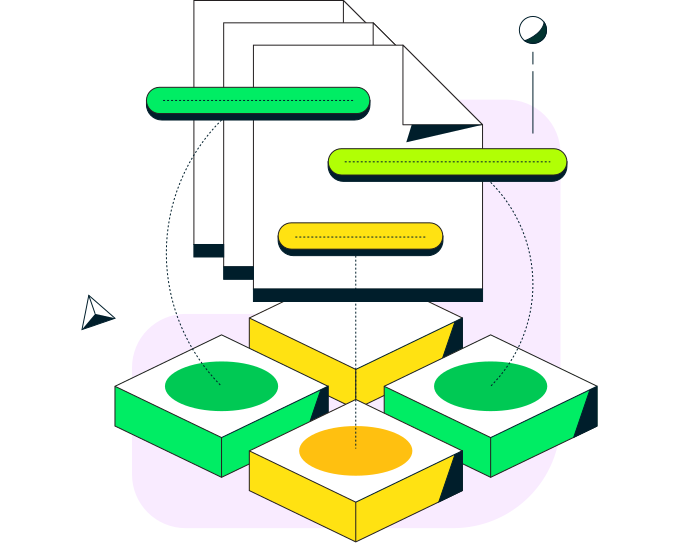
Atlas Search makes it easy to build fast, relevant, full-text search on top of your data in the cloud. By embedding an Apache Lucene search engine directly alongside your database, data is automatically synchronized between the two systems. This means developers work with a single driver and API, and there is no separate system to run or pay for—everything is fully managed for you.
Atlas Data Federation
Atlas Data Federation allows you to natively query and combine data across MongoDB Atlas and AWS S3 without complex integrations. Spin up a Federated Database Instance alongside your Atlas database from a common UI and begin working with rich data immediately. Federate queries using a single endpoint or seamlessly combine and transform data across storage tiers without time-consuming ETL processes. Leverage a fully-integrated, scalable query engine to control costs and unlock value from your data faster.
_(1).svg)
Atlas Charts
Atlas Charts offers a quick, simple, and powerful way to visualize your data from Atlas and Atlas Data Federation. Made for the document model and integrated with Atlas, Charts requires no setup or ETL to get started. Build charts in minutes, and easily share them with your team. The Charts embedding SDK lets you embed your charts into any website or application to enrich customer experiences.
Atlas App Services
Atlas App Services help you to build key features faster by simplifying the code required to stand up both mobile and web applications. Atlas App Services provides a fully managed, serverless back end and automatically manages the flow of data between MongoDB Atlas and client devices.
Application services like triggers and functions make it easy to implement dynamic application logic, and developers can lean on production-ready APIs to connect and integrate Atlas data with ease.

Atlas Device Sync
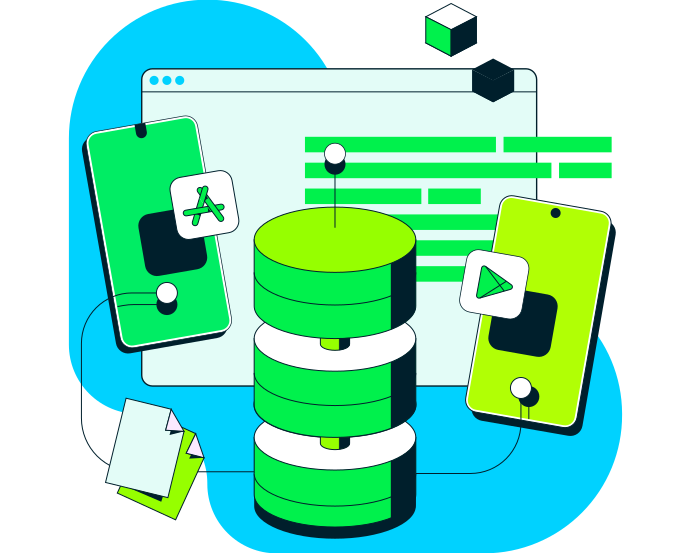
The data platform is extended to the edge by Atlas Device Sync, a real-time data synchronization solution that works between the edge (Realm) and the back end (MongoDB Atlas) to keep data current and accurate. Used in combination with Realm—a fast, performant alternative to SQLite—Atlas Device Sync makes it easy for you to build collaborative, real-time apps that work regardless of internet connection.
Atlas Data Lake
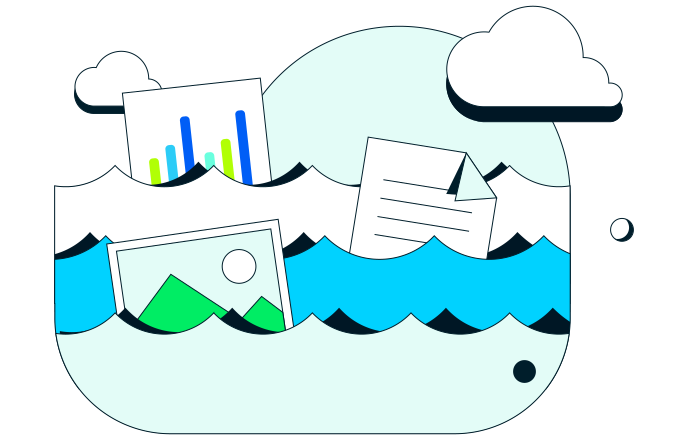
Atlas Data Lake is a fully managed storage solution that provides the economics of cloud object storage and is optimized for analytical queries. Atlas Data Lake reformats, creates partition indexes, and partitions data as it is ingested, creating an isolated workload ready to support large and complex analytical queries. Rich analytical insights are delivered whilst not degrading the performance of your production application.
Platform integrations

Management
Manage your infrastructure as code with Kubernetes and Terraform integrations. Configure monitoring and alerting in DataDog, Slack, Sumo Logic, PagerDuty, VictorOps, and more.

Security
Authenticate database users with LDAP, AWS IAM, or your own identity provider via SAML. You can also manage secrets with Hashicorp Vault. Bring your own encryption key with key management integrations. Network peering to cloud providers and use of AWS PrivateLink is fully supported.

Data Connections
Use MongoDB Connectors to integrate with the other data tools you use, including Kafka, Spark, Rockset, and most BI and visualization tools.
If you don’t see the connector you need, you can always use the rest-like Atlas Data API or the GraphQL API. Both are instantly-generated APIs that help you access and integrate your Atlas data.

Development Tools
Use MongoDB Compass, the free native GUI for MongoDB, or work in your usual IDE with integrations for VS Code and JetBrains products.

Drivers
Of course, you can access MongoDB Atlas directly from application code. With more than a dozen drivers for the most popular languages, you can use a library that lets you write queries idiomatically in your application.
Get started with Atlas Database today
- One unified account
- Up to 5 GB storage
- Shared RAM & vCPU
- Atlas Database
- Atlas Search
- Atlas Charts