Docs Home → Develop Applications → MongoDB Manual
Documents
On this page
MongoDB stores data records as BSON documents. BSON is a binary representation of JSON documents, though it contains more data types than JSON. For the BSON spec, see bsonspec.org. See also BSON Types.
Compatibility
MongoDB stores records as documents for deployments hosted in the following environments:
MongoDB Atlas: The fully managed service for MongoDB deployments in the cloud
MongoDB Enterprise: The subscription-based, self-managed version of MongoDB
MongoDB Community: The source-available, free-to-use, and self-managed version of MongoDB
Document Structure
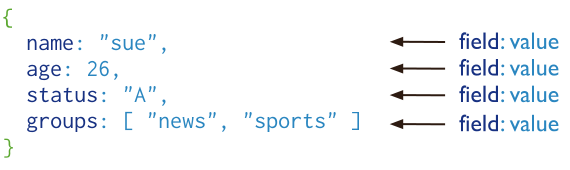
MongoDB documents are composed of field-and-value pairs and have the following structure:
{ field1: value1, field2: value2, field3: value3, ... fieldN: valueN }
The value of a field can be any of the BSON data types, including other documents, arrays, and arrays of documents. For example, the following document contains values of varying types:
var mydoc = { _id: ObjectId("5099803df3f4948bd2f98391"), name: { first: "Alan", last: "Turing" }, birth: new Date('Jun 23, 1912'), death: new Date('Jun 07, 1954'), contribs: [ "Turing machine", "Turing test", "Turingery" ], views : NumberLong(1250000) }
The above fields have the following data types:
_idholds an ObjectId.nameholds an embedded document that contains the fieldsfirstandlast.birthanddeathhold values of the Date type.contribsholds an array of strings.viewsholds a value of the NumberLong type.
Field Names
Field names are strings.
Documents have the following restrictions on field names:
The field name
_idis reserved for use as a primary key; its value must be unique in the collection, is immutable, and may be of any type other than an array. If the_idcontains subfields, the subfield names cannot begin with a ($) symbol.
Field names cannot contain the
nullcharacter.The server permits storage of field names that contain dots (
.) and dollar signs ($).MongodB 5.0 adds improved support for the use of (
$) and (.) in field names. There are some restrictions. See Field Name Considerations for more details.
The MongoDB Query Language does not support documents with duplicate field names. While some BSON builders may support creating a BSON document with duplicate field names, inserting these documents into MongoDB is not supported even if the insert succeeds, or appears to succeed. For example, inserting a BSON document with duplicate field names through a MongoDB driver may result in the driver silently dropping the duplicate values prior to insertion, or may result in an invalid document being inserted that contains duplicate fields. Querying against any such documents would lead to arbitrary and inconsistent results.
Field Value Limit
- MongoDB 2.6 through MongoDB versions with featureCompatibilityVersion (fCV) set to
"4.0"or earlier - For indexed collections, the values for the indexed fields have a Maximum Index Key Length. See Maximum Index Key Length for details.
Dot Notation
MongoDB uses the dot notation to access the elements of an array and to access the fields of an embedded document.
Arrays
To specify or access an element of an array by the zero-based index
position, concatenate the array name with the dot (.) and
zero-based index position, and enclose in quotes:
"<array>.<index>"
For example, given the following field in a document:
{ ... contribs: [ "Turing machine", "Turing test", "Turingery" ], ... }
To specify the third element in the contribs array, use the dot
notation "contribs.2".
For examples querying arrays, see:
Tip
See also:
$[]all positional operator for update operations,$[<identifier>]filtered positional operator for update operations,$positional operator for update operations,$projection operator when array index position is unknownQuery an Array for dot notation examples with arrays.
Embedded Documents
To specify or access a field of an embedded document with dot notation,
concatenate the embedded document name with the dot (.) and
the field name, and enclose in quotes:
"<embedded document>.<field>"
For example, given the following field in a document:
{ ... name: { first: "Alan", last: "Turing" }, contact: { phone: { type: "cell", number: "111-222-3333" } }, ... }
To specify the field named
lastin thenamefield, use the dot notation"name.last".To specify the
numberin thephonedocument in thecontactfield, use the dot notation"contact.phone.number".
Warning
Partition fields cannot use field names that contain a dot (.).
For examples querying embedded documents, see:
Document Limitations
Documents have the following attributes:
Document Size Limit
The maximum BSON document size is 16 megabytes.
The maximum document size helps ensure that a single document cannot
use excessive amount of RAM or, during transmission, excessive amount
of bandwidth. To store documents larger than the maximum size, MongoDB
provides the GridFS API. See mongofiles and the
documentation for your driver for more
information about GridFS.
Document Field Order
Unlike JavaScript objects, the fields in a BSON document are ordered.
Field Order in Queries
For queries, the field order behavior is as follows:
When comparing documents, field ordering is significant. For example, when comparing documents with fields
aandbin a query:{a: 1, b: 1}is equal to{a: 1, b: 1}{a: 1, b: 1}is not equal to{b: 1, a: 1}
For efficient query execution, the query engine may reorder fields during query processing. Among other cases, reordering fields may occur when processing these projection operators:
$project,$addFields,$set, and$unset.Field reordering may occur in intermediate results as well as the final results returned by a query.
Because some operations may reorder fields, you should not rely on specific field ordering in the results returned by a query that uses the projection operators listed earlier.
Field Order in Write Operations
For write operations, MongoDB preserves the order of the document fields except for the following cases:
The
_idfield is always the first field in the document.Updates that include
renamingof field names may result in the reordering of fields in the document.
The _id Field
In MongoDB, each document stored in a collection requires a unique
_id field that acts as a primary key. If an inserted
document omits the _id field, the MongoDB driver automatically
generates an ObjectId for the _id field.
This also applies to documents inserted through update operations with upsert: true.
The _id field has the following behavior and constraints:
By default, MongoDB creates a unique index on the
_idfield during the creation of a collection.The
_idfield is always the first field in the documents. If the server receives a document that does not have the_idfield first, then the server will move the field to the beginning.
- _ If the
_idcontains subfields, the subfield names cannot begin - with a (
$) symbol.
The
_idfield may contain values of any BSON data type, other than an array, regex, or undefined.Warning
To ensure functioning replication, do not store values that are of the BSON regular expression type in the
_idfield.
The following are common options for storing values for _id:
Use an ObjectId.
Use a natural unique identifier, if available. This saves space and avoids an additional index.
Generate an auto-incrementing number.
Generate a UUID in your application code. For a more efficient storage of the UUID values in the collection and in the
_idindex, store the UUID as a value of the BSONBinDatatype.Index keys that are of the
BinDatatype are more efficiently stored in the index if:the binary subtype value is in the range of 0-7 or 128-135, and
the length of the byte array is: 0, 1, 2, 3, 4, 5, 6, 7, 8, 10, 12, 14, 16, 20, 24, or 32.
Use your driver's BSON UUID facility to generate UUIDs. Be aware that driver implementations may implement UUID serialization and deserialization logic differently, which may not be fully compatible with other drivers. See your driver documentation for information concerning UUID interoperability.
Note
Most MongoDB driver clients will include the _id field and
generate an ObjectId before sending the insert operation to
MongoDB; however, if the client sends a document without an _id
field, the mongod will add the _id field and generate
the ObjectId.
Other Uses of the Document Structure
In addition to defining data records, MongoDB uses the document structure throughout, including but not limited to: query filters, update specifications documents, and index specification documents
Query Filter Documents
Query filter documents specify the conditions that determine which records to select for read, update, and delete operations.
You can use <field>:<value> expressions to specify the equality
condition and query operator
expressions.
{ <field1>: <value1>, <field2>: { <operator>: <value> }, ... }
For examples, see:
Update Specification Documents
Update specification documents use update operators to specify the data modifications to perform on specific fields during an update operation.
{ <operator1>: { <field1>: <value1>, ... }, <operator2>: { <field2>: <value2>, ... }, ... }
For examples, see Update specifications.
Index Specification Documents
Index specification documents define the field to index and the index type:
{ <field1>: <type1>, <field2>: <type2>, ... }
Further Reading
For more information on the MongoDB document model, download the MongoDB Application Modernization Guide.
The download includes the following resources:
Presentation on the methodology of data modeling with MongoDB
White paper covering best practices and considerations for migrating to MongoDB from an RDBMS data model
Reference MongoDB schema with its RDBMS equivalent
Application Modernization scorecard